Conversational artificial intelligence is no longer a futuristic idea. It powers the helpful chatbot on a website, the voice assistant in your home, and the virtual agent answering customers at 2 a.m. Without breaks, without queues, and without frustration, when it is done well, virtual agent assist is essential for scaling customer support. Using a virtual agent for call centers and customer experience ensures businesses can meet customer needs efficiently while providing consistent, high-quality interactions.
For organizations exploring how to implement advanced AI tools, learning from resources like cutting-edge AI solutions at FlashMob Computing can provide practical insights. These platforms highlight how conversational systems improve real-world business workflows. Similarly, supercomputer platforms for AI applications demonstrate the power behind handling large-scale customer interactions, giving teams the speed and reliability needed to maintain excellent service.
Marketing plays a crucial role in designing the voice and behavior of virtual agents. Guides such as strategies for effective customer marketing help companies tailor AI responses to resonate naturally with users. Additionally, learning from modern AI marketing practices allows brands to create more personalized, engaging interactions that feel human, not robotic. For finance and service industries, top financial resources for AI implementation provide practical frameworks for measuring performance and ensuring that AI-driven support meets both efficiency and compliance standards.
If you are exploring how to use conversational AI in your organization, you are in the right place. This guide walks through what conversational AI is, how it works, where it delivers the most value, and how to roll it out successfully. With the right approach, businesses can harness the full potential of AI-driven virtual agents to enhance both customer experience and operational efficiency.
Top 10 Contact Center Solutions for Conversational Artificial Intelligence
1. Bright Pattern – AI Contact Center Solutions
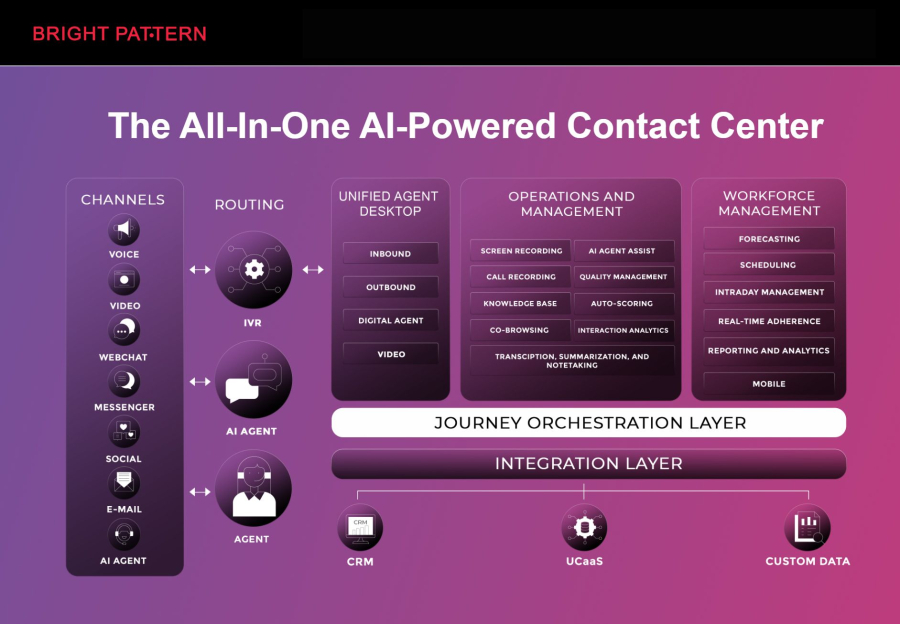
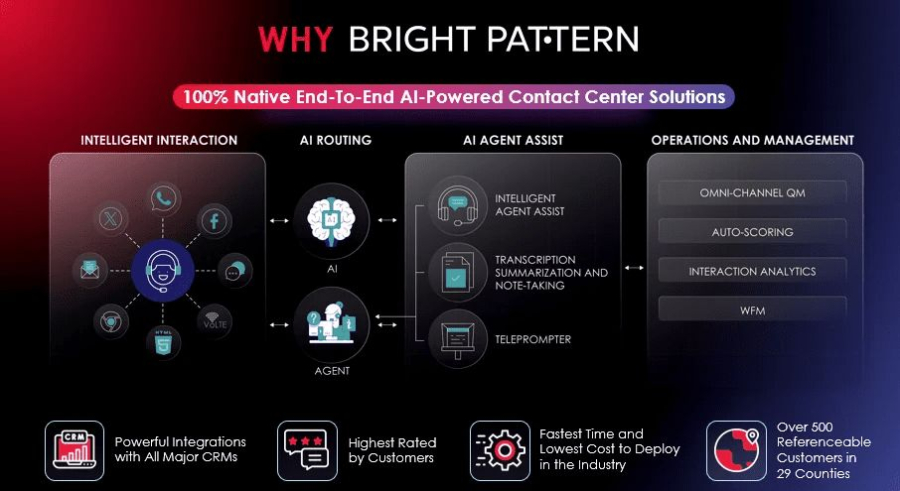
Bright Pattern is a leading provider of AI-driven contact center solutions that empower businesses to deliver seamless customer experiences. By integrating conversational artificial intelligence, Bright Pattern allows organizations to automate routine inquiries, assist agents in real-time, and provide consistent support across multiple channels.
Key features of Bright Pattern include:
- Omnichannel support across voice, chat, email, SMS, and social media
- AI‑powered virtual agents for handling high-volume customer interactions
- Intelligent routing to connect customers with the right agent instantly
- Real-time analytics to monitor performance and optimize workflows
- Easy integration with CRM systems for unified customer data
Bright Pattern’s platform is ideal for businesses looking to scale support without compromising on quality, making it a top choice for AI contact center solutions.
2. Genesys Cloud CX
Genesys Cloud CX offers cloud-based contact center services with AI capabilities to improve engagement. Its conversational AI solutions assist in automating repetitive tasks and enhancing agent productivity.
3. Five9 Intelligent Cloud Contact Center
Five9 combines cloud contact center software with AI-powered tools to deliver superior customer support. Predictive dialing, automated workflows, and virtual assistants help streamline operations.
4. NICE CXone
NICE CXone provides a unified platform for contact center management, integrating AI-driven analytics and virtual agent support to optimize customer interactions.
5. Talkdesk AI‑Powered Contact Center
Talkdesk leverages AI to enhance customer service through intelligent automation, real-time insights, and omnichannel communication capabilities.
6. Cisco Contact Center Solutions
Cisco offers enterprise-grade contact center solutions with AI features such as virtual agents, speech analytics, and customer journey insights.
7. Avaya OneCloud
Avaya’s cloud-based contact center solutions incorporate AI and omnichannel capabilities, enabling businesses to provide support across voice, chat, email, and messaging. Their platform offers customizable workflows, intelligent routing, and integrations with existing systems.
8. RingCentral Contact Center with AI
RingCentral provides cloud contact center software with conversational AI tools for managing interactions, routing customers efficiently, and improving agent efficiency.
9. 8x8 Contact Center AI
8x8 combines cloud-based communication tools with AI capabilities to enable smarter routing, automated responses, and real-time agent assistance.
10. Twilio Flex
Twilio Flex is a programmable cloud contact center platform that integrates conversational AI. It allows businesses to customize workflows and communication channels, automate messaging and voice interactions, and connect with customers at scale.
What Is Conversational Artificial Intelligence?
Conversational artificial intelligenceis a set of technologies that enable computers to understand, process, and respond to human language in a natural, humanlike way. It powers applications such as:
- Chatbots on websites, in mobile apps, and inside messaging platforms
- Virtual agents that handle customer service or IT support
- Voice assistants and voice bots for phone calls or smart speakers
- In app assistants that guide users through complex tasks
Unlike simple scripted bots that can only follow predefined buttons or rigid rules, modern conversational AI can interpret free form text or speech, keep track of context, and adapt its responses as the conversation unfolds.
The goal is simple but powerful: make interacting with technology feel more like talking to a helpful human, and less like fighting with a form or a menu.
How Conversational AI Works (Without the Jargon)
Under the hood, conversational artificial intelligence relies on several building blocks that work together to understand and generate language.
1. Natural Language Processing (NLP)
Natural language processingis the broader field that teaches computers to work with human language. In conversational AI, NLP helps with tasks like:
- Breaking a sentence into words and phrases
- Identifying parts of speech, like nouns and verbs
- Handling spelling mistakes, slang, and shorthand
- Recognizing that different phrases can mean the same thing
NLP is what allows a system to see that "reset password", "I cannot log in", and "forgot my login" are all related to the same type of request.
2. Natural Language Understanding (NLU)
Natural language understandingis the part that figures out the intent behind the words. NLU answers questions like:
- What is this person trying to do or ask?
- What key details are they providing, like dates, locations, or product names?
- Is this message urgent, frustrated, or positive?
For example, in the message, "Can you move my flight to next Tuesday morning?", NLU would identify an intent likechange bookingand extract details such asflightandnext Tuesday morning.
3. Dialogue Management
Dialogue managementis the brain of the conversation. It decides what should happen next, based on what the user just said and what has already happened in the conversation.
Dialogue management is responsible for tasks such as:
- Keeping track of context across multiple messages
- Asking follow up questions when information is missing
- Choosing whether to answer directly, look up data, or hand over to a human
- Making sure conversations stay on track and reach a useful outcome
4. Natural Language Generation (NLG)
Natural language generationhandles crafting responses that feel clear and natural. Instead of sending robotic messages, NLG helps the system respond in everyday language, adjust tone, and vary phrasing.
This can be as simple as selecting a pre written message, or as advanced as dynamically composing replies based on data, policies, and the user’s previous messages.
5. Machine Learning and Large Language Models
Modern conversational AI usesmachine learningandlarge language modelsto improve over time and handle a wide variety of phrasing. These models are trained on large collections of text so they can recognize patterns, predict likely responses, and generalize to new situations.
In practice, this means your virtual assistant can get better as it sees more real conversations. It can learn which replies resolve issues, which questions tend to confuse people, and which conversations should be routed to human agents faster.
6. Integrations With Your Systems
To be truly useful, conversational AI must connect to your existing systems, such as:
- Customer relationship management platforms
- Order management and logistics tools
- Booking, billing, or reservation systems
- Internal knowledge bases and FAQs
These integrations allow the assistant to do more than just answer questions. It can perform real actions, such as updating an address, processing a refund, booking an appointment, or checking an order status in real time.
Why Conversational AI Matters for Businesses
Conversational artificial intelligence delivers tangible, business ready benefits. When implemented thoughtfully, it can transform both customer experience and internal operations.
1. Always On, Instant Customer Support
Customers now expect answers when it suits them, not just during business hours. Conversational AI gives you:
- 24/7 availabilitywithout staffing extra shifts
- Instant responsesthat reduce waiting times and abandon rates
- Consistent qualityacross every conversation and channel
Instead of sitting in a phone queue, customers can get help on your website, in your mobile app, or through messaging channels whenever they need it.
2. Lower Operational Costs With Higher Quality
Many support teams handle a large volume of repetitive questions that follow a predictable pattern. Conversational AI can take care of that long tail of simple requests, such as:
- Checking an order or delivery status
- Resetting a password
- Answering product or policy questions
- Helping users navigate your site or app
By automating these routine interactions, you reduce the cost per contact and allow human agents to focus on higher value, more complex cases. The result is often a better experience for both customers and employees.
3. Increased Revenue and Conversion
Conversational AI can also play an active role in sales and marketing, for example by:
- Guiding visitors to the right product or plan based on their needs
- Answering pre purchase questions that might block a sale
- Capturing leads and qualifying them in real time
- Re engaging visitors who are about to abandon a cart or form
Because conversations are two way and interactive, they can surface needs that static pages or one way campaigns might miss. That creates more opportunities to recommend relevant products or services at the right moment.
4. Rich Customer Insights From Real Conversations
Every interaction with a conversational AI system can be analyzed to uncover patterns in what customers really want and where they struggle. Over time, you can use these insights to:
- Identify gaps in your content, products, or processes
- Spot frequent pain points and prioritize fixes
- Refine your marketing and messaging based on real language customers use
- Improve training materials for human agents
Instead of relying solely on surveys or assumptions, you get a living, searchable record of what matters most to your audience.
5. Happier, More Productive Teams
Conversational AI does not replace humans. It supports them. By handling repetitive queries, virtual assistants free up employees to spend more time on work that requires judgment, empathy, and creativity.
For support teams, this can mean:
- Fewer tickets that feel repetitive and draining
- More time for complex, rewarding problem solving
- Less pressure during peak volumes, because the assistant absorbs the initial load
For internal teams, a well designed virtual assistant can answer routine HR, IT, or policy questions, cutting down on internal emails and interruptions.
Common Use Cases for Conversational AI
Conversational AI is flexible. It can support many functions across your organization. Below are some of the most impactful use cases.
Customer Service and Support
Customer service is often the first place organizations deploy conversational AI. Popular applications include:
- Answering frequently asked questions in real time
- Helping customers troubleshoot simple issues
- Taking care of account updates or status checks
- Routing complex issues quickly to the right human agent
In many cases, customers get faster resolutions, and human agents enjoy a more manageable workload.
Sales Assistance and Product Guidance
Conversational AI can act as a digital sales assistant by:
- Recommending products or plans based on user preferences
- Explaining differences between options in plain language
- Collecting contact details for follow up when live sales staff are unavailable
- Answering compatibility or feature questions during the buying journey
This kind of guided, conversational experience helps customers feel more confident about their choices, which can naturally improve conversion rates.
Marketing and Engagement
Marketers use conversational AI to create more interactive, personalized experiences, such as:
- Welcoming new visitors and suggesting relevant content based on their interests
- Running interactive quizzes that educate while capturing preferences
- Nurturing leads with timely, conversational follow ups
- Re engaging dormant users with targeted, helpful prompts
Because the experience feels like a conversation rather than a broadcast, engagement often feels more natural and less intrusive.
Internal Helpdesks (IT and HR)
Inside the organization, conversational AI can streamline access to information and support by:
- Answering employee questions about policies, benefits, or procedures
- Helping staff reset passwords or access systems
- Guiding new hires through onboarding steps
- Logging and categorizing internal support requests automatically
This reduces the repetitive load on internal teams while giving employees faster, on demand access to what they need.
Industry Specific Examples
Every industry has its own opportunities for conversational AI. Here are a few examples:
- Retail and ecommerce: Product recommendations, order tracking, returns and exchanges, store information.
- Banking and financial services: Balance inquiries, transaction history, card replacement, appointment booking with advisors.
- Travel and hospitality: Booking assistance, itinerary changes, check in support, local recommendations.
- Healthcare: Appointment scheduling, pre visit questionnaires, basic guidance on services and procedures.
- Education: Course information, enrollment help, campus FAQs, student services assistance.
Key Components of a Successful Conversational AI Solution
Not all chatbots and virtual agents are created equal. The most effective conversational AI implementations tend to share a few important characteristics.
1. Omnichannel Presence
Customers move fluidly between channels, so your assistant should too. A strong solution can be deployed across:
- Websites and mobile apps
- Messaging platforms and live chat widgets
- Voice channels and phone systems
Ideally, the experience feels consistent, and the assistant can recognize returning users, maintaining context as much as your systems allow.
2. Deep Integration With Business Systems
Surface level chat experiences that cannot access real data quickly feel limited. A powerful conversational AI connects securely to your core systems while respecting privacy and security requirements. This allows it to:
- Retrieve personalized information for authenticated users
- Initiate workflows, such as placing orders or creating tickets
- Update records when customers change their details
The closer the assistant is to your real business processes, the more value it can create.
3. Easy, No Code or Low Code Configuration
Business teams should be able to contribute directly to conversational experiences. Tools that offer no code or low code interfaces make it easier to:
- Define conversation flows and intents
- Update responses and content quickly
- Experiment with new use cases without long development cycles
This flexibility helps your assistant stay aligned with evolving products, services, and customer expectations.
4. Human in the Loop Escalation
Even the best conversational AI will not handle every situation perfectly, and it does not need to. A well designed solution makes it easy to:
- Recognize when a user is frustrated or when the system is unsure
- Offer a smooth handover to a human agent, without repeating information
- Allow human agents to see the conversation history and continue naturally
This combination of automation plus human expertise keeps satisfaction high while still unlocking major efficiency gains.
5. Robust Analytics and Continuous Improvement
Strong reporting is essential. You want visibility into:
- Which intents and topics are most common
- How often conversations are resolved automatically
- Where users drop off or ask to speak to a person
- Which content or flows lead to the best outcomes
Armed with this data, you can continuously refine your assistant, expanding what it can do and improving how it responds.
Planning and Implementing Conversational AI in Your Organization
Rolling out conversational AI does not have to be overwhelming. A structured approach helps you launch quickly while still laying a strong foundation.
Step 1: Define Clear Objectives
Start by deciding what success looks like. Common objectives include:
- Reducing average handling time for routine queries
- Improving first contact resolution rates
- Increasing online conversion rates or lead capture
- Extending support coverage without increasing headcount
Clear goals make it easier to choose the right use cases and measure impact.
Step 2: Identify High Impact Use Cases
Focus first on tasks that are:
- Frequent: Questions or requests that appear often in your support logs.
- Structured: Interactions that follow a predictable pattern.
- Low risk: Scenarios where automated responses are unlikely to cause issues.
Good early candidates might include delivery tracking, appointment scheduling, or simple account questions.
Step 3: Map Conversation Flows
For each use case, outline the typical conversation paths. Consider:
- How users usually phrase their questions
- What information the assistant needs to gather
- Possible edge cases, such as missing data or wrong inputs
- When to escalate to a human agent
Even though large language models can handle open ended text, having clear goals and flows ensures the assistant reliably moves conversations toward resolution.
Step 4: Prepare Content and Knowledge
Your assistant is only as helpful as the knowledge behind it. Take time to:
- Gather and organize existing FAQs, policies, and help articles
- Write concise, customer friendly answers in plain language
- Align responses with your brand voice and tone
- Clarify what the assistant can and cannot answer at launch
This preparation ensures the assistant gives helpful, accurate, and consistent guidance from day one.
Step 5: Integrate With Systems and Channels
Decide where your assistant will live and what it needs to connect to. Typical steps include:
- Embedding the assistant on key pages of your website
- Adding it inside your mobile app, if you have one
- Configuring access to customer data or ticketing systems
- Setting up secure authentication where required
Starting on one or two channels is often enough for an initial launch. You can extend to more channels as you see value.
Step 6: Pilot, Learn, and Expand
Launch with a focused pilot, gather feedback, and adjust. During this phase, pay attention to:
- Questions the assistant cannot yet answer
- Where users seem confused or ask for clarification
- Topics that cause frequent handovers to human agents
Use these insights to expand coverage, refine wording, and train new intents. Over time, your assistant can grow from a narrow support tool into a broader digital companion across journeys.
Best Practices for Designing Great Conversations
The underlying technology matters, but the experience design matters just as much. A few best practices make a noticeable difference in how users feel about your assistant.
1. Set Expectations Upfront
Be transparent about what the assistant can do. A short, friendly introduction works well, such as:
"I am your virtual assistant. I can help with order tracking, billing questions, and appointment changes. If I get stuck, I will connect you with a person."
Clear expectations build trust and reduce frustration if a topic is out of scope.
2. Use Natural, Human Language
Write responses the way your team would speak to customers:
- Prefer short sentences and everyday words
- Avoid internal jargon or technical terms where possible
- Include empathy, especially when users are facing problems
A natural tone makes interacting with the assistant feel comfortable, not mechanical.
3. Keep Users in Control
Great conversations feel collaborative, not rigid. Help users stay in control by:
- Allowing free text input instead of only buttons
- Offering clear choices when decisions are needed
- Providing an easy path to a human agent at any point
When users feel they can steer the interaction, they are more likely to trust and adopt the assistant.
4. Handle Uncertainty Gracefully
No AI model understands everything. Design for uncertainty:
- Ask clarifying questions when the intent is unclear
- Offer helpful alternatives, such as related topics
- Escalate rather than guessing in sensitive situations
A thoughtful "I am not sure, let me connect you with a colleague" is far better than a confident but wrong response.
5. Respect Privacy and Security
Customers share personal and sometimes sensitive information during conversations. Make sure your solution:
- Follows relevant regulations and industry standards
- Protects data in transit and at rest
- Clearly communicates how information will be used
- Avoids requesting unnecessary personal details
Trust is a major asset. Designing for privacy and security from the start helps you preserve it.
Measuring Success: Key Metrics for Conversational AI
To understand the impact of conversational AI on your business, track a mix of efficiency, experience, and revenue metrics.
Efficiency Metrics
- Automation rate: The share of conversations fully handled by the assistant without human intervention.
- Deflection rate: The percentage of contacts that do not reach human agents because the assistant resolved them.
- Average handling time: Time saved per interaction compared to fully human handling.
Customer Experience Metrics
- Customer satisfaction scoresafter interactions with the assistant.
- Resolution rate: How often customers get a complete answer or solution in one interaction.
- Drop off rate: Where users abandon conversations and why.
Business Impact Metrics
- Conversion liftin journeys where the assistant is available.
- Lead volume and qualitycaptured through conversational flows.
- Cost per contactfor automated versus fully human channels.
By tracking these indicators over time, you can demonstrate the value of conversational AI and identify the next areas to optimize.
The Future of Conversational AI
Conversational artificial intelligence is advancing rapidly. Several trends are shaping what comes next.
More Personalized, Context Aware Experiences
Future assistants will make greater use of context, such as past purchases, previous conversations, and current activity, to tailor responses. Instead of generic answers, users will receive guidance that reflects their history and preferences, within the limits of your privacy policies.
Closer Collaboration Between Humans and AI
Rather than replacing human agents, conversational AI will increasingly augment them. For example, assistants can:
- Summarize long conversations for quick handover
- Suggest responses or next best actions to human agents
- Highlight potential issues or priorities based on language cues
This kind of collaboration blends the speed and scale of AI with the empathy and judgement of people.
Deeper Integration Across the Customer Journey
As organizations see strong results in support, they are extending conversational AI into more stages of the customer journey, including discovery, onboarding, and ongoing account management. The assistant can become a consistent, familiar presence that helps customers at every step.
Richer Multimodal Interactions
Conversational AI is moving beyond text and voice to support more multimodal experiences. In practice, this can mean:
- Combining text, buttons, and visuals inside a chat to simplify complex choices
- Using voice plus on screen elements in mobile or in car interfaces
- Augmenting traditional channels like email with conversational follow ups
The underlying idea remains the same: let people communicate in the way that feels most natural for the task at hand.
Choosing the Right Conversational AI Platform
When you are ready to adopt conversational AI, selecting the right platform is crucial. Consider these factors:
Technical Capabilities
- Support for both text and voice channels if you need them
- Strong natural language understanding across your key
